


Control Board
The control board is the brain of an asic: it holds the firmware, the network and the web interface, and it hands jobs out to the hashboards.
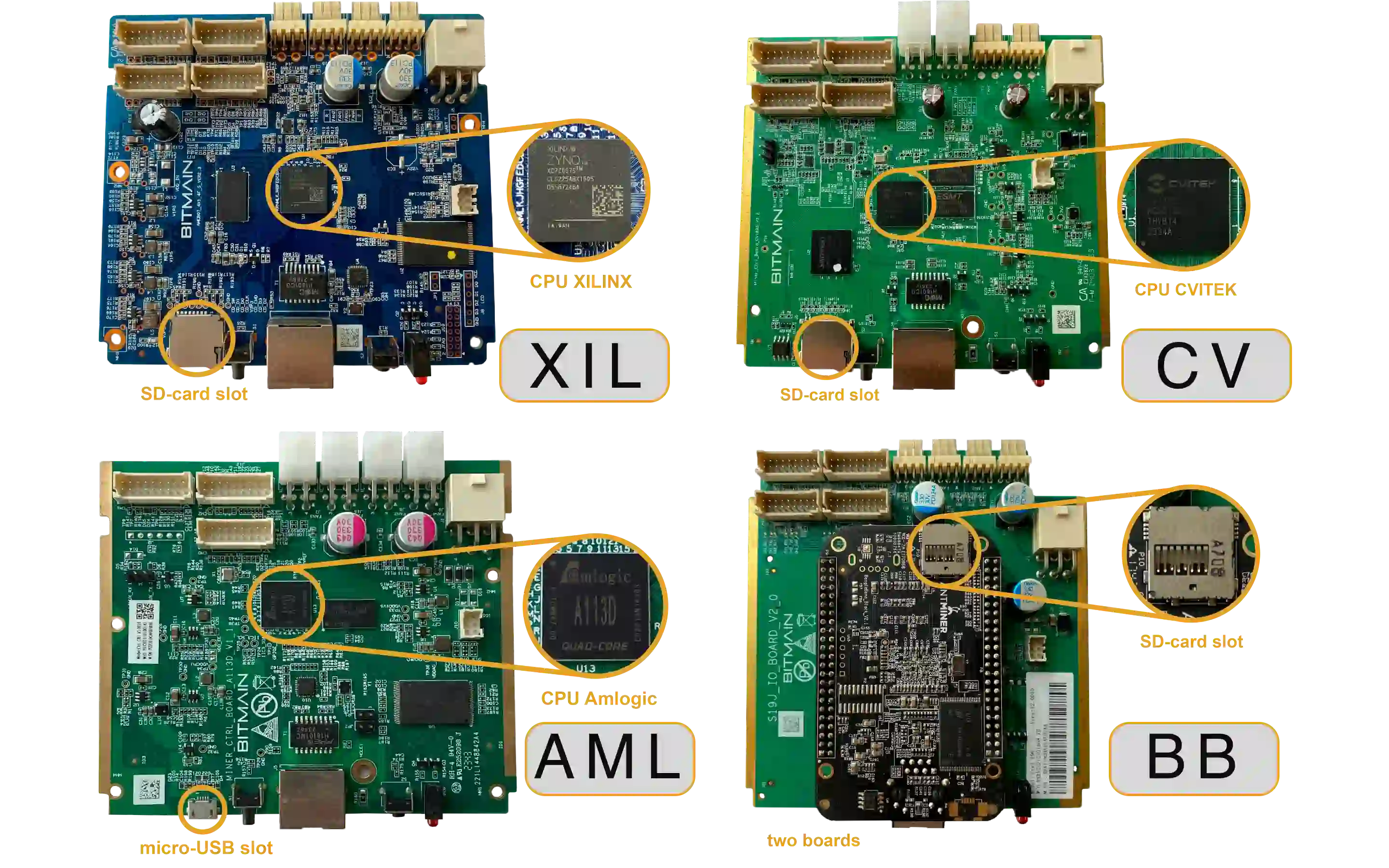
What a control board is
Physically it is a small board with a processor, memory and an Ethernet jack. The firmware lives on it, and it talks to the pool over Stratum, watches temperatures and fans, and gives the hashboards their jobs. It does no hashing at all.
Bitmain has several types of these boards across generations, and that matters in repair: the flashing procedure and compatibility follow the board type rather than the model name. We put the details on generations of chips and boards on the chips page, where you can also see what each series is built on.
The symptoms of a sick control board are recognizable: the asic takes no address on the network, serves no web interface, freezes a few minutes after start or fails to see some of the hashboards while power is fine. A separate story is locked access on boards with Amlogic, for which we have a dedicated unlock guide.
Quick reference table
| What it does | holds the firmware, the network and control |
| Hashrate | does no hashing, only hands out jobs |
| Connectors | Ethernet, ribbon cables to the hashboards |
| Failure symptoms | no network, no interface, freezes |
| Compatibility | by board type, not by model name |
What to do when you suspect the control board
Rule out the network first. Another cable, another port, a look at the address leases on the router. Half of the dead control board cases end with a new patch cord.
Then see whether the asic starts and what the logs say. A board that comes up, works for a few minutes and then reboots usually suffers from power rather than from the processor: measure the supply output voltages under load.
Reflashing comes last, and only with an image for your own series. Firmware from another board type is a reliable way to get a brick that you then pull out of recovery mode.
An example from the bench
The asic is loud, the fans spin, the worker stays quiet in the pool and no address shows up on the network. We swap the cable, move it to another port, check the address leases: silence. Then we measure the power and read the boot log. That sequence takes fifteen minutes and in most cases it answers the question of who is at fault.
Related terms
Where to go next on the site
Hardware
- ASIC Chip and Hashboard knowledge base
- ASIC Miner knowledge base
Software
- Software firmware
- HashCore Toolkit firmware
Questions and answers
Does the control board affect hashrate
Not directly, since it does no hashing. Indirectly yes: when it reboots or loses the link, the miner idles, and that shows up as fallen uptime.
Can you fit a board from another model
Only one of a compatible type. Connectors can match while the architecture differs, and the experiment ends in a repair that costs more than the board.
What if access to the board is locked
On some Amlogic boards an unlock procedure fixes it, and we have a separate page with the steps.
How the terms connect
Every link in the chain is clickable. Orange marks where you are now.
Looking for an ASIC miner
The catalog holds 212 models. You can compare them by hashrate and by joules per terahash, then plug your own rate into the calculator and see what stays in your pocket.
Page written and checked by Denys Klimchuk. Updated .