Mining pools explained: how they work and where to point your ASIC
Eight pools in one comparison, payout schemes in plain words, picks for 14 coins and a walkthrough of connection errors. The data is checked against pool documentation, volatile figures are given as a snapshot on 8 August 2026.
DKDenys Klimchuk·updated ·sections: 25·about an hour of reading
1What a mining pool is
A mining pool merges the computing power of many miners into a single stream. Every connected ASIC grinds through hash candidates for one shared block, and when any participant finally hits that block, the reward is split among everyone in proportion to the work they put in. The pool operator runs the servers, builds the block templates, keeps a record of what each miner contributes and sends out the payouts.
Pools did not appear because life was good. By the end of 2010 the difficulty of the Bitcoin network had climbed so high that a single computer could spend months hunting for a block. A programmer named Marek Palatinus, better known by the handle Slush, proposed stacking hashpower and splitting the reward. That is how Slush Pool got started. Today it goes by Braiins Pool, and over its history it has mined more than 1.3 million BTC.
Here is the key thing to get straight right away: a pool does not mine faster. A thousand ASICs inside a pool have exactly the same combined chance of finding a block as those same thousand working on their own. What a pool changes is not the expected value, it is the spread. Instead of a lottery with a rare big win, you get a steady trickle of small payouts.
A pool is run by an ordinary company with its own servers and its own rates. Behind Antpool stands Bitmain, behind Foundry USA the American Digital Currency Group, behind Braiins a team in Prague. Whoever builds the block template also decides which transactions go into it. Out of that one fact grows a whole conversation about centralization, and we will come back to it.
In shortA pool makes its money on the fee, usually 1 to 4 percent of your reward. In exchange it takes on the variance and the entire infrastructure. Further down we look at when that fee is justified and when you are simply overpaying.
Fifteen years in four paragraphs
The first era, from Slush Pool through 2013, was an amateur affair: pools were written by enthusiasts, mining ran on graphics cards, and payout schemes were invented on the fly. That is exactly when PPLNS showed up, along with the Slush score method aimed at people who hopped between pools.
Then came ASICs, and with them the first big scare: in the summer of 2014 GHash.io pushed past half of the network hashrate. It ended without an attack, the pool itself asked miners to leave and promised to stay below 40 percent, but the word “centralization” never dropped off the agenda after that. The decade that followed belonged to Chinese operations: F2Pool, Antpool, BTC.com and ViaBTC divided most of the network among themselves.
China's mining ban in the summer of 2021 redrew the map in half a year: the hardware moved to North America and Central Asia, and the American pool Foundry took first place, where it sits to this day. The market also grew up in the worst sense of the word: in the fall of 2022 Poolin, one of the former leaders, came apart and froze client funds.
The current chapter is institutionalization and the answer to it. On one side you get KYC, negotiated rates, pools attached to exchanges and funds. On the other, Ocean, DMND and Stratum V2, handing control over blocks back to miners themselves. Both trends are growing at the same time, and we like the second one better.
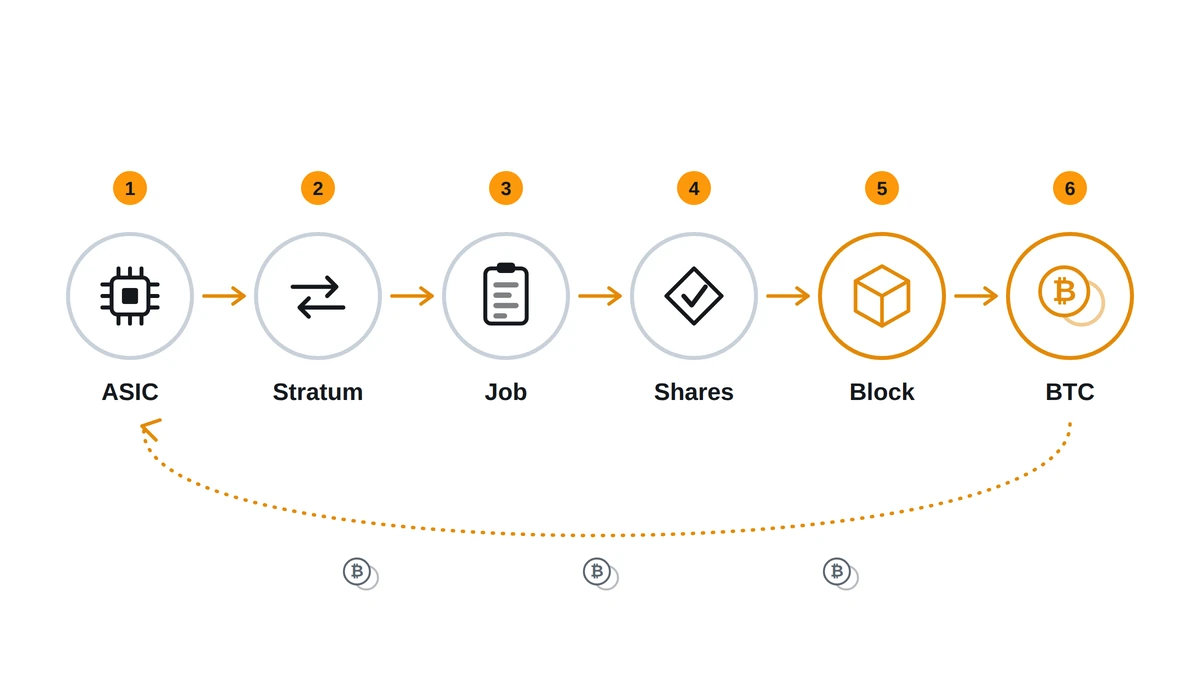
The road from job to payout. Shares flow in constantly, a block happens rarely.
The cycle looks like this. A miner connects to the pool server over the Stratum protocol, receives a job and starts running through nonce values, a service field in the block header. Every attempt produces a new hash. A full block needs a hash below the target for the whole network, but the pool also accepts easier results, and those are called shares.
The ASIC connects to the pool at an address like stratum+tcp://host:port
The pool hands out a job: a block template and a target share difficulty
The miner runs through nonces and hashes the header billions of times per second
Every hash below the share threshold goes to the server as proof of work
One of the participants finds a hash below the network target, and that is a finished block
The pool publishes the block, collects the reward and splits it by the shares on record
The share is the unit of accounting. Finding one is thousands of times easier than finding a block, so even a single Antminer S21 turns them in every few seconds. From that stream of shares the pool knows precisely how much work each miner did, and it splits the reward fairly without waiting for your particular ASIC to catch a block.
The pool tunes share difficulty automatically, and the mechanism is called vardiff. Shares that arrive too often clog the connection, shares that arrive too rarely make the hashrate hard to measure accurately. Braiins, for instance, aims for 16 to 20 shares per minute from a worker. Higher difficulty takes nothing away from your income: a share at difficulty 20 counts as 20 units of work.
An important term from the pool statistics page: luck, plain and simple. It is the ratio of the expected number of shares per block to the actual number. Find a block twice as fast as the math predicts and luck reads 200 percent. Take three times as long and it reads 33 percent. Hashes have no memory, so over a long run the luck of any honest pool converges on 100 percent, and short dips and spikes are ordinary variance, not evidence of cheating.
What happens when a block is found
The server verifies the solution it received and instantly pushes the block out across the network, and here the clock runs in milliseconds. Sometimes two pools find blocks at the same height almost simultaneously, and the network accepts only one, while the second becomes an orphan and its reward burns. At a normal pool the orphan rate stays below a tenth of a percent, but this is one reason infrastructure and well connected servers are worth their fees.
Next comes the wait for maturity: the Bitcoin rules forbid spending the reward from the coinbase transaction for the first 100 blocks, roughly 17 hours. So even at the fastest pool, freshly mined coins arrive with a delay, and that is not operator greed, it is network consensus.
The strong points are the same at every pool, whatever the brand.
Predictable payouts: on the FPPS scheme the money lands every day, even if the pool has gone a week without a block
Any scale works: one ASIC on a balcony or a warehouse holding a thousand of them
No need to run your own node, watch block templates or keep up with protocol updates
Statistics for every worker: hashrate, rejects, payout history, idle alerts
Now let us be honest about the price of all that.
A fee of 1 to 4 percent on every payout, and more with brokers and aggregators
You are trusting the operator: he keeps the share records, and almost nowhere can you verify them directly
Your funds sit with the pool until payout. The Poolin precedent, which froze 163 million dollars of client money in 2022 and reached bankruptcy in July 2026, is not worth forgetting
Large pools concentrate the right to assemble blocks, and that is a systemic risk for the entire network
Worth knowingA rule from our own practice: keep the bare minimum on your pool balance. Set up an automatic withdrawal to your own wallet at the lowest threshold and do not use the pool as a piggy bank. The Poolin story started with exactly that phrase, “withdrawals are temporarily paused”.
Solo mining is the same lottery without splitting the prize. Find a block and the whole reward is yours, right now that is 3.125 BTC plus network fees. Find nothing and you get nothing. The only question is how long the wait runs.
Let us do the math on a live example. In early August 2026 the Bitcoin network hashrate holds around 995 EH/s. An Antminer S21 puts out 200 TH/s, which is one five millionth of the network. At 144 blocks a day, the average wait for a block of your own comes out to about 95 years. The odds of catching a block even once in a year are roughly one percent. No ASIC lives that long, and you are most likely not eager to find out.
Pool
Solo
Payouts
regular, as often as daily
only when a block turns up
Income spread
a few percent
all or nothing
Fee
0 to 4%
0 to 2% at solo pools
Block reward
split among everyone
all yours, 3.125 BTC plus fees
Who it suits
practically everyone
big farms and fatalists
The comparison is fair: the expected value is identical, only the distribution differs.
Solo blocks do happen, and regularly at that. Since June 2023 lone miners have found more than fifty blocks, and in the spring of 2026 alone Solo CKPool, Public Pool, Braiins Solo and Parasite Pool all made the list. Each of those finds brought in 200 to 300 thousand dollars. Here is how it works: a solo pool like solo.ckpool.org takes 0 to 2 percent for infrastructure, and the entire reward goes to whoever found the block. CKPool, by the way, has a European server in Germany.
Who does solo actually make sense for. For anyone with enough hashpower to keep the wait reasonable: at 10 PH/s the average time to a block is about two years. And for anyone who knowingly bets on luck with one small ASIC, the way people buy a lottery ticket. A Bitaxe on the kitchen counter with a shot at 3.125 BTC is a hobby with a price tag you can see. Let the main fleet keep working in a pool while it runs.
In shortViaBTC shut down its solo modes across every coin on May 20, 2026, and the accounts were moved to PPS+ and PPLNS. If an older review still tells you about “solo on ViaBTC”, that is history now.
The difference between a good pool choice and a bad one is a few percent of your annual income and, in the bad scenario, frozen funds. Here are the points we go through ourselves whenever a client asks for advice.
Payout scheme and fee. FPPS is smoother, PPLNS is usually cheaper. Compare the effective fee, not the number in the ad: details in the section on fees.
Minimum payout. For a single ASIC a threshold of 0.005 BTC means waiting weeks to get paid. Braiins sets the threshold at 0.0002 BTC, and over Lightning it starts at 1 satoshi.
Servers close by. From Spain you want a European endpoint: every extra 100 ms of latency adds stale shares. F2Pool gives you btc-euro.f2pool.com, Braiins and Antpool use geo routing.
Support for your coin. A pool for BTC is easy to find anywhere, but for KDA or HNS the choice has shrunk down to Antpool.
Signup requirements. Since 2025 Antpool has required verification with face recognition, and Foundry works with institutional clients only. Ocean, on the contrary, does not ask for an account at all.
Transparent accounting. Open statistics on blocks and shares, a public list of blocks found, and a way to double check your own shares.
DDoS resistance and backup ports. Serious pools keep several ports and addresses, and the miner switches over by itself.
Reputation and age. A pool that has survived two market cycles is safer than a brand new site with zero history and a 0% fee.
How you actually get paid. A direct withdrawal to your own wallet on a schedule beats an internal balance with manual withdrawals.
One detail that matters in Spain: check whether the pool is open to EU residents. After MiCA took effect a number of services left the market, and a recent example is broken down in the section on jurisdictions.
Red flags that make us turn around
A promise of fixed returns. A pool cannot guarantee income, it controls neither the difficulty nor the exchange rate. Guarantees in this field are a sign of a pyramid, not generosity.
No public list of blocks found. An honest pool has nothing to hide: its blocks show up in the chain explorer and it is proud of them.
A referral program more generous than the fee. When bringing in people pays a service better than mining does, you already understand where the payouts come from.
A clone domain of a well known pool with a “promo” and a request to send a deposit. Pools do not take deposits, in mining the money flows only toward you.
An anonymous team plus a site that is a couple of months old. Checking the age of a domain takes a minute through whois.
The payout scheme decides who carries the risk of bad stretches: you or the pool. That is where the difference in fees comes from. Let us walk through each scheme in plain words.
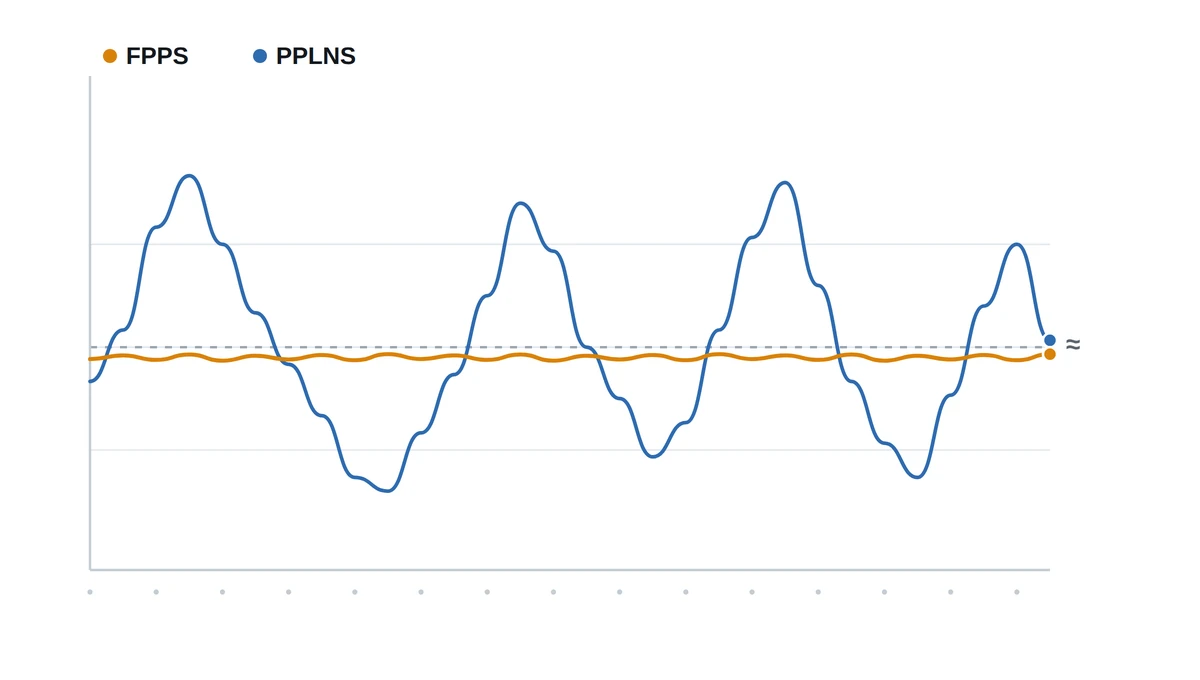
FPPS smooths everything out, PPLNS repeats the luck curve of the pool. Averaged over a year they converge.
PPS, pay per share
The pool pays a fixed price for every accepted share, whether it found a block or not. The price of a share comes from the block subsidy and the current network difficulty. All of the variance lands on the pool, which is why pure PPS costs more than the other schemes and in 2026 you hardly ever see it at large pools, FPPS crowded it out.
FPPS, full PPS
The same thing, plus a cut of network fees: the pool takes the average fees across the whole network for a period and spreads them over shares, again with no regard for its own finds. Your income barely moves from one day to the next. This is the industry standard: it is how Foundry, Braiins and Luxor pay, and on one of their plans Antpool and F2Pool too. The flip side: the fee on this scheme is the highest, usually 2.5 to 4 percent.
PPS+
A hybrid. The block subsidy is paid to you PPS style, steadily and without a glance at luck. Network fees, meanwhile, are split only out of the blocks the pool really found. A little more fluctuation than FPPS, a slightly lower rate. This is the main scheme at ViaBTC.
PPLNS, paid out of what gets found
No guarantees at all: you get paid only when the pool finds a block, and the reward is divided by shares inside a window of the last N of them. The pool gets lucky and your income runs above the estimate. Two weeks of bad luck and nothing reaches your account. For putting up with that ride you are rewarded with a lower fee: at F2Pool on BTC it is 2 percent against 4 on FPPS, and at Antpool the PPLNS rate is zero altogether. Stretched over a year, honest PPLNS beats FPPS by exactly the difference in fees.
TIDES, the Ocean variant
A development of the PPLNS idea with verifiable accounting: the share window equals eight times the network difficulty, each share gets paid on average eight times, and the payout is written straight into the coinbase transaction of the block that was found. The money never sits on a pool balance at all, it arrives at your address the moment the block is published. The price of that elegance: the threshold for making it into a payout is around 0.0105 BTC of accumulated share, so a small miner will have to wait or turn to Lightning.
Scheme
Who carries the risk
Typical fee
Income swings
Who it suits
FPPS
the pool
2.5 to 4%
minimal
anyone who values predictability
PPS
the pool
high, the scheme is fading
minimal
a historical option
PPS+
split down the middle
2 to 4%
small
a compromise without extremes
PPLNS
the miner
0 to 2%
noticeable
the patient, counting on a year
TIDES
the miner
1 to 2%
noticeable
those who want verifiability and their own address
Solo
the miner entirely
0 to 2%
all or nothing
large hashpower
The rates follow pool documentation as of August 2026, check the exact numbers in your account.
The FPPS formula on a napkin
Checking a pool by hand is not hard. Your expected daily income equals your slice of the network multiplied by the daily emission: divide the hashrate of your ASIC by the network hashrate, multiply by 144 blocks, then by the reward of 3.125 BTC plus average network fees, and subtract the pool percentage. For an S21 at 200 TH/s with the network around 995 EH/s the slice works out to roughly two times ten to the minus seventh. All four multipliers are public: mempool.space publishes the network hashrate and the fees, and the rate is written in your account. If your actual credits for a week sit consistently below the estimate by more than a percent or two, start asking the pool questions.
In shortA simple rule. One or two ASICs and a wish to see even numbers: take FPPS. Ready to treat a month as your unit of measurement: PPLNS at the same pool will hand you a couple of percent more. The expected value is the same across schemes, all you pay for is the smoothing.
We picked the pools that actually matter to a miner in Spain and the EU in 2026. Left out of the lineup: Binance Pool, which walked away from the European market together with the exchange, and services aimed at other regions. The network shares in the cards come from the weekly mempool.space snapshot of August 8, 2026.
Foundry USA
largest, 24.85% of the BTC network
Works with2020, USA
Payout schemesFPPS
Feenot published, rates are negotiated
Minimum BTC payoutabout 0.001 BTC according to third party reviews
Stratum V2in the working group since May 2026
Servers in Europelocations are not published
KYCyes, mandatory
Appno
The number one pool by Bitcoin hashrate since late 2021. It belongs to Digital Currency Group, has been running since October 2020, and opened to the public in March 2021. It serves listed companies and large North American farms: mandatory KYC, negotiated rates, no signing yourself up from the website.
For a private miner in Europe this is a showcase, not an option: you simply cannot point a home ASIC at it. That said, in April 2026 Foundry launched a separate institutional pool for Zcash and gathered about 30 percent of the ZEC network right out of the gate. A telling wake-up call for any conversation about concentration.
Antpool
17.25% of the BTC network
Works with2014, China, Bitmain
Payout schemesFPPS, PPS+, PPLNS, SOLO
FeeFPPS up to 4%, PPS+ 2.5%, PPLNS 0%
Minimum BTC payoutfrom 0.001 to 0.005 BTC, sources disagree
Stratum V2in the working group since May 2026
Servers in Europeyes, 12 data centers on 4 continents
KYCyes, with face recognition
AppiOS and Android
Bitmain's pool, running since 2014. The main practical upside: the coin list is wider than anyone else's in the big five. Besides BTC it takes Scrypt miners on LTC with DOGE, and it supports Kaspa, Dash, Zcash, Nervos, Alephium, ETC and even networks the big pools have walked away from: Kadena and Handshake.
What to know before you sign up. First: since 2025 identity verification is mandatory, face recognition included. Second: researcher b10c showed that another dozen or so formally independent pools run Antpool block templates, which means Bitmain's real weight in the network is higher than the headline number. Nothing has been published against its payout accounting, and the rates are among the most flexible out there: PPLNS with no fee at all.
ViaBTC
7.89% of the BTC network
Works with2016, China, global operations
Payout schemesPPS+, PPLNS
FeePPS+ 4%, PPLNS 2%
Minimum BTC payoutregular payout from 0.001 BTC, auto payout from 0.01
Stratum V2no
Servers in Europeyes, a strong presence in Europe
KYCin 2026 required for some accounts
AppiOS and Android
Founded in 2016 and a steady leader in European presence among SHA-256 pools. Ten coins from our catalog, including the rare eCash. It is closely tied to the CoinEx exchange: moving what you mine to the exchange is instant and free, which reads as convenience to some and as one more dependency to others.
Fresh news. SOLO mode has been closed on every coin since May 20, 2026. The official BTC auto payout threshold is on the high side at 0.01 BTC, but a regular withdrawal works from roughly 0.001. In 2026 users in certain countries reported sudden verification demands, so build that into your plan if you register without documents.
F2Pool
18.03% of the BTC network
Works with2013, founded in Beijing
Payout schemesFPPS, PPLNS, PPS
FeeBTC: FPPS 4%, PPLNS 2%; KAS and ALPH: PPLNS 1%
Minimum BTC payout0.005 BTC, the threshold is adjustable
Stratum V2in the working group since May 2026
Servers in Europeyes, btc-euro.f2pool.com
KYCyes
Appyes
One of the oldest pools, running since 2013, and in 2026 it climbed to second place on BTC. For a European it is convenient thanks to the explicit regional endpoint btc-euro.f2pool.com:1314 and a port with encryption. On Scrypt it is flat out the biggest pool in the world by power, and along with Litecoin and Dogecoin it hands out five more merged mining coins: Bellscoin, Luckycoin, Pepecoin, Dingocoin. Small change, but free change, just link your wallet addresses.
The blot in the biography: in November 2023 F2Pool admitted that it had filtered transactions from addresses on the OFAC sanctions lists, which made it the first major pool with a documented case of censorship. After the wave of criticism the filter was switched off. The story is instructive: every pool has the technical ability, the only question is policy.
Braiins Pool
1.85% of the BTC network
Works with2010, Czech Republic, Prague
Payout schemesFPPS
Fee2.5%, and 0% with Braiins OS
Minimum BTC payoutfrom 0.0002 BTC, over Lightning from 1 satoshi
Stratum V2yes, running in production
Servers in Europeyes, an EU company, nodes assigned by geolocation
KYCno
AppiOS and Android
This is the very Slush Pool from 2010, the first pool in history, now under the Braiins name and registered in Prague. For small and midsize miners in the EU it is our standard advice: registration without verification, a withdrawal threshold of 0.0002 BTC, Lightning payouts from a single satoshi, servers picked by geolocation, and a company that sits in a European jurisdiction.
Technically the pool runs ahead of the industry: it co-created the Stratum V2 protocol and is one of the two pools where it really works in production. The fee is 2.5 percent on FPPS, and if your miner runs their Braiins OS firmware the fee goes to zero. In April 2025 Braiins landed on the list of "friends of Antpool" in b10c's research, the company publicly denied it, the methodology there is probabilistic, and the question stays open.
Luxor
3.02% of the BTC network
Works with2017, USA
Payout schemesFPPS
FeeBTC 2.5%, LTC and DOGE 3%, ZEC 3%
Minimum BTC payout0.001 BTC
Stratum V2no
Servers in Europea single address with geo routing
KYCnone required
Appno, web only
An American pool from 2017 with a tilt toward analytics: the Hashprice index and the Hashrate Index research that the whole industry quotes come from the Luxor team itself. One scheme only, FPPS, a fee of 2.5 percent on BTC and 3 on Scrypt and Zcash. The withdrawal threshold is 0.001 BTC and payouts land daily.
The distinctive part: hashrate futures and fixed payouts up front, tools built for farms rather than for a garage. There is no mobile app, everything goes through the web. The documentation calls out no separate European addresses, you connect through a shared address with routing by region.
Ocean
3.80% of the BTC network
Works with2023, USA
Payout schemesTIDES
Fee2%, 1% with DATUM
Minimum BTC payoutthreshold 0.0105 BTC, lower over Lightning
Stratum V2no, its own DATUM protocol
Servers in Europelocations are not published
KYCno, you do not even need an account
Appno
The most principled project on the list. Luke Dashjr launched it at the end of 2023 on seed money from Jack Dorsey, with the goal of giving miners back control over blocks. There is no account at all: your BTC address serves as the worker, the payout arrives straight in the coinbase transaction of the block that was found, and the pool never holds your money for a minute.
The start turned into a scandal: in December 2023 the pool filtered out some transactions by default and drew accusations of censorship. The answer was the DATUM protocol: now the miner assembles the block template on its own side and the pool only validates it. With DATUM the fee falls from 2 to 1 percent. The downside for small miners: the threshold for making it into a payout sits around 0.0105 BTC, which takes weeks to build up at 200 TH/s, and Lightning is what bails you out.
NiceHash
marketplace, Slovenia
Works with2014, Slovenia, EU
Payout schemesмаркетплейс
Feeabout 2% on seller payouts
Minimum BTC payout0.001 BTC, over Lightning from 0.0001
Stratum V2no
Servers in Europeyes, most servers are in Europe
KYCnot needed for mining
AppiOS and Android
Formally not a pool but a hashrate exchange, and for an EU resident it is the only service on the list whose parent company sits inside the union. You point your miner at their stratum, an anonymous buyer purchases the power, and you get paid daily in BTC no matter which coin your ASIC was crunching. More than 30 algorithms are supported, from SHA-256 and Scrypt to kHeavyHash.
Payment always comes in bitcoin, which is worth remembering if you own Scrypt or Kaspa miners: you cannot stack the coin itself through NiceHash. The company covered the December 2017 hack of 4700 BTC in full, returning all the funds by the end of 2020, so the reputation test is passed. Returns usually run a bit below a direct pool, but you get algorithm switching and payment in BTC on autopilot.
Every key parameter of the eight services in one place. We checked the fees and thresholds against the official documentation in early August 2026, but rates change with no announcement: before you connect a fleet, look inside the pool dashboard.
Checked against pool documentation, status as of 8 August 2026. The column Coins from our catalog counts the networks in our reference that the pool supports.
How to read the table. For a single BTC ASIC, look first at the minimum payout and KYC, then at the fee: the difference between 2 and 4 percent on one Antminer S21 runs to about a hundred dollars a year at current economics. For a farm of ten miners and up it flips: stability and servers first, the fee gets negotiated with the pool directly, and most of them have VIP rates from 1 PH/s.
The algorithm of your miner rigidly sets the list of networks, and the network sets the list of pools. The table covers the 14 coins that have write-ups in our reference, and only the pools from this article. Smaller specialized pools exist in almost every network, and we mention them in the commentary.
after Kadena shut down in October 2025 the choice narrowed to almost nothing
Coin support was verified in the connection guides of the pools themselves, status as of 8 August 2026.
The pattern jumps out at you: the smaller the network, the shorter the list. On Bitcoin you choose among dozens of venues, on Kadena and Handshake practically only Antpool is left. That is a direct risk for the owner of a narrowly specialized miner: a pool can drop a coin, the way F2Pool dropped Handshake in December 2024 and ViaBTC did in June 2026. A Blake2s miner moves nowhere after that, because there is simply nowhere to go.
In shortBefore you buy an ASIC for a niche coin, count the pools that are actually alive. Fewer than three is a yellow flag, no matter how pretty the profit looks in the calculator.
Pools pay owners of Scrypt miners in two coins at once, and that is not a promotion, it is a property of the protocol. The mechanism is called AuxPoW: your miner does the work for Litecoin, and the Dogecoin chain accepts the proof of that same work. The attached network needs no extra power whatsoever, so DOGE comes to you physically free.
That is how every large Scrypt pool works: Antpool, ViaBTC, F2Pool, Luxor. Mining Dogecoin on its own is impossible in principle, the network has no noticeable hashrate of its own and has lived on Litecoin's shoulders since 2014. For the owner of an Antminer L7 or L9 this means one simple thing: when you compare pools, look at the combined payout across both coins, not at one of them.
F2Pool went further and hands out five more AuxPoW coins together with LTC: Bellscoin, Luckycoin, Pepecoin, Dingocoin and on down the list, the lineup changes. Payout thresholds are gentle, from 40 DOGE and from 1 BELLS. One trap: for every bonus coin you have to link a wallet address in the dashboard. No address, and the reward piles up for nothing and burns.
Worth knowingBonus coins beyond DOGE are barely liquid: selling Luckycoin for euros is far harder than earning it. Treat them as pleasant dust, not as part of a business plan. A detailed breakdown of Scrypt economics sits on the algorithm page.
After the Crescendo hard fork in May 2025, the Kaspa network puts out ten blocks per second. For a miner that is a different pool physics: blocks stopped being an event, the reward for each one is ten times smaller than it used to be, but the variance smoothed out. Simulations after the fork put a solo miner's daily income in a band from 83 to 111 percent of the expected figure, where the spread used to be twice as wide. PPLNS barely gets shaken on a network like this.
The flip side of that speed: jobs from the pool arrive in a stream, and pools throttle it differently, some send a new job twice a second, some once every two. The more often they come, the fresher the fees inside the block, but the more you need a short and stable link. For miners in the Antminer KS5 class, pick a pool with a European endpoint and keep the unit on a cable, the penalty for latency here is higher than in Bitcoin.
From our list, Kaspa is taken by ViaBTC, F2Pool and Antpool, and among the specialized ones Kryptex, K1Pool and 2Miners stand out. No custom firmware exists for kHeavyHash on any model, so comparing pools here is simpler: rate, stability and ping, with no correction for software.
Pick a coin and your requirements, and the tool shows the matching options among the eight services covered here, with their rates. The data is baked into the page as of August 2026 and gets updated along with it.
None of the eight services covered here fit these conditions. Loosen a filter or look at the coin specific pools in the table above.
The link in the first column takes you to the pool review higher up the page. If the list comes back empty after filtering, then none of the major venues fit your conditions: either loosen a filter, or look at the specialized pools for that specific coin, which are listed in the coin table.
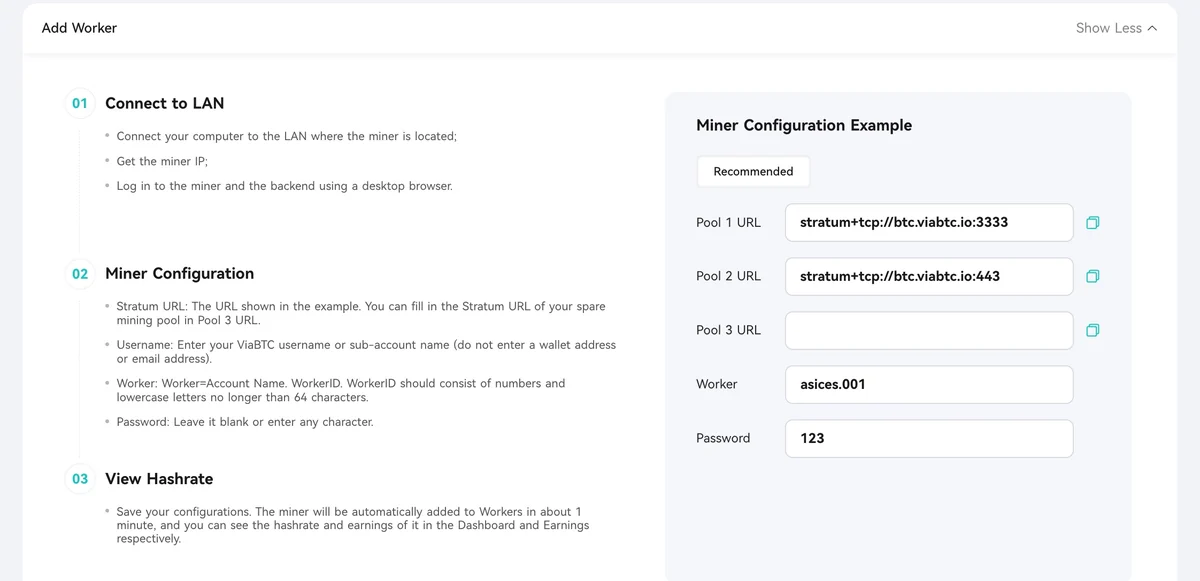
The whole setup takes about ten minutes and happens in the web interface of the miner. We will walk through an Antminer; on WhatsMiner and the rest only the menu labels are different.
Slot
Server address
Worker
Password
1, primary
stratum+tcp://btc-euro.f2pool.com:1314
account.worker
x
2, backup
stratum+ssl://btcssl.f2pool.com:1300
account.worker
x
3, second backup
stratum+tcp://stratum.braiins.com:3333
account.worker
x
Three slots in the miner interface. The addresses come from the pool documentation, the worker and password follow the format your pool asks for. The miner switches to the backup on its own if the first server stops answering.
Sign up at the pool and create an account. Ocean skips this step: your BTC address serves as the worker.
Find the connection section in your pool dashboard and write down the server addresses. For Europe, take the regional address if there is one.
Open the web interface of the miner at its IP, miner configuration tab.
Fill in all three pool slots: the main one and two backups. A backup can be another server of the same pool or a completely different pool.
Enter the worker as account.miner_name and a password, x is usually enough.
Save, wait for the restart and after 10 minutes check that the hashrate on the pool matches the local one.
The pool side: this is where the server addresses come from and where you name the worker. The table above tells you where to type those values on the miner.
Live examples out of the pool documentation: F2Pool has the European stratum+tcp://btc-euro.f2pool.com:1314 and the encrypted stratum+ssl://btcssl.f2pool.com:1300, Braiins runs a single stratum+tcp://stratum.braiins.com:3333 with routing by geolocation, and at Antpool the encrypted option lives on port 443. For solo experiments there is solo.ckpool.org with a server in Germany.
Worth knowingA port from an example on somebody else's site may be closed or may have moved. The only reliable source of addresses is the dashboard of your own pool. And do not mix up stratum+tcp with stratum+ssl: the protocol in the address has to match the port, otherwise you get Socket connect failed.
The firmware does not care which pool it hashes for: both the factory build and our AsicBoost work with any server over Stratum. AsicBoost carries a built in DevFee of 2.8 percent, it goes out over a separate connection and never shows up in the statistics of your pool. If you need to put the miner back to stock after flashing, the Bitmain factory builds with checksums are in our catalog.
When you have more than three ASICs
As the fleet grows, setup moves out of the miner interface and into the network. Pin a permanent IP to every ASIC with a DHCP reservation on the router, otherwise you will be hunting for your units all over again after the power goes out. Miners are asking for a separate network segment, well away from home devices: they push noisy traffic and they carry open web interfaces. And start a table: worker name, IP, serial number, purchase date, firmware. Sounds tedious, saves you hours on every incident.
WhatsMiner works exactly the same way: three pool slots, worker, password. Only the interface login and the factory credentials are different, the logic is identical, so a mixed fleet of Bitmain and MicroBT lives on one pool with no contortions.
A worker is the accounting unit for one ASIC on the pool. The format is the same everywhere: account login, dot, name of the miner. With the account garaje, your first S21 becomes garaje.s21-01, the second one garaje.s21-02. The worker password does exist in the protocol, but almost nobody checks it, so put x there and never think about it again.
Naming looks like a trifle right up until the tenth miner. After that, with no system in place you stop knowing which of the "worker3" units overheated. At our service shop we use the model-rack-position scheme: the name s19j-r2-07 tells you right away where to walk with the screwdriver. Latin letters, digits and the hyphen work in a name, pools will not take Cyrillic or spaces.
One worker per ASIC. You can technically hang ten miners on a single name, but the statistics and the downtime alerts turn into mush.
Use subaccounts for sites: a separate subaccount for the garage and another one for the container makes both your bookkeeping and your tax reporting easier.
Worker down alerts take a couple of clicks to set up on the pool, over Telegram or by email. Turn them on right away, learning about a full day of downtime from your payout stings a lot more.
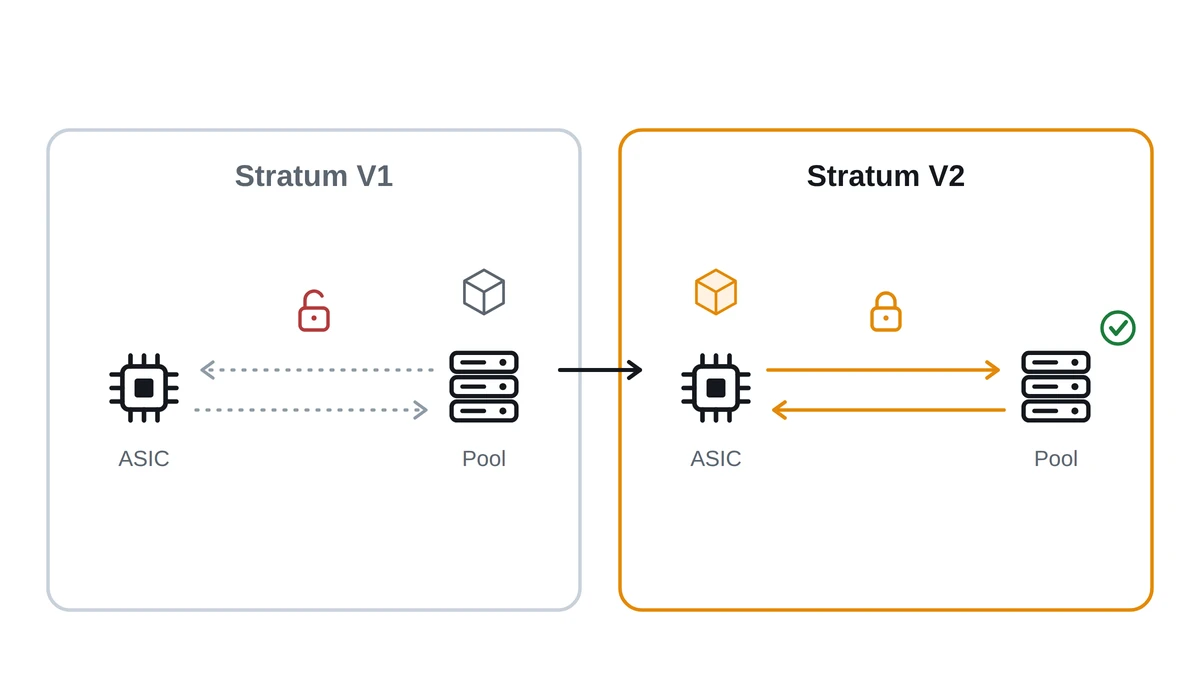
Stratum is the language an ASIC speaks with a pool. The first version showed up in 2012 and it still serves almost all the hashrate on the planet: text JSON over TCP, no encryption and, more to the point, with the pool in full control of what goes into the block.
V1 has three birth defects. The traffic travels in plain text, so your provider or an attacker on the network can swap out the payout address, an attack known as hashrate hijacking. The miner waits for jobs from the pool and trusts them blindly. And the choice of transactions in the block belongs entirely to the operator, hence the stories about filtering at F2Pool and at early Ocean.
The main thing about V2 is not speed, it is handing the right to build the block from the pool to the miner.
Stratum V2 closes all three of those: a binary protocol with encryption and, above all, the Job Declaration mechanism, where the miner assembles the block template and the pool only checks it. On June 25, 2026 the scheme worked in the wild for the first time: block 955318 was put together by the miner GoMining through the DMND pool. As of today two pools run V2 in production, Braiins and DMND. A noticeable shift is coming: in May 2026 seven pools that account for something like three quarters of Bitcoin hashrate joined the working group for the protocol, but most of them still have no live endpoints.
Does your ASIC need V2 right now. Stock Antminer and WhatsMiner firmware speaks V1 only, native V2 support comes with Braiins OS. There is a middle road: a local translating proxy from the open SRI project, it lets any V1 unit talk to a V2 pool. Ocean solves the same task with its own DATUM protocol: the template is built locally at the miner, and the fee drops to 1 percent.
Why the switch has been dragging on for fourteen years and still has not landed. The incentives went separate ways: the whole network gets the benefit of V2, while the cost of rolling it out falls on the pools and the firmware makers, who are doing just fine on V1. Add the inertia of the installed fleet: nobody is going to reflash millions of ASICs running stock software all at once. Most likely V2 will take hold the way SSL did on the web: slowly, through proxies and new firmware, until one day it turns out that only museum pieces still run the old way.
16Pool statistics: what to watch and how to read it
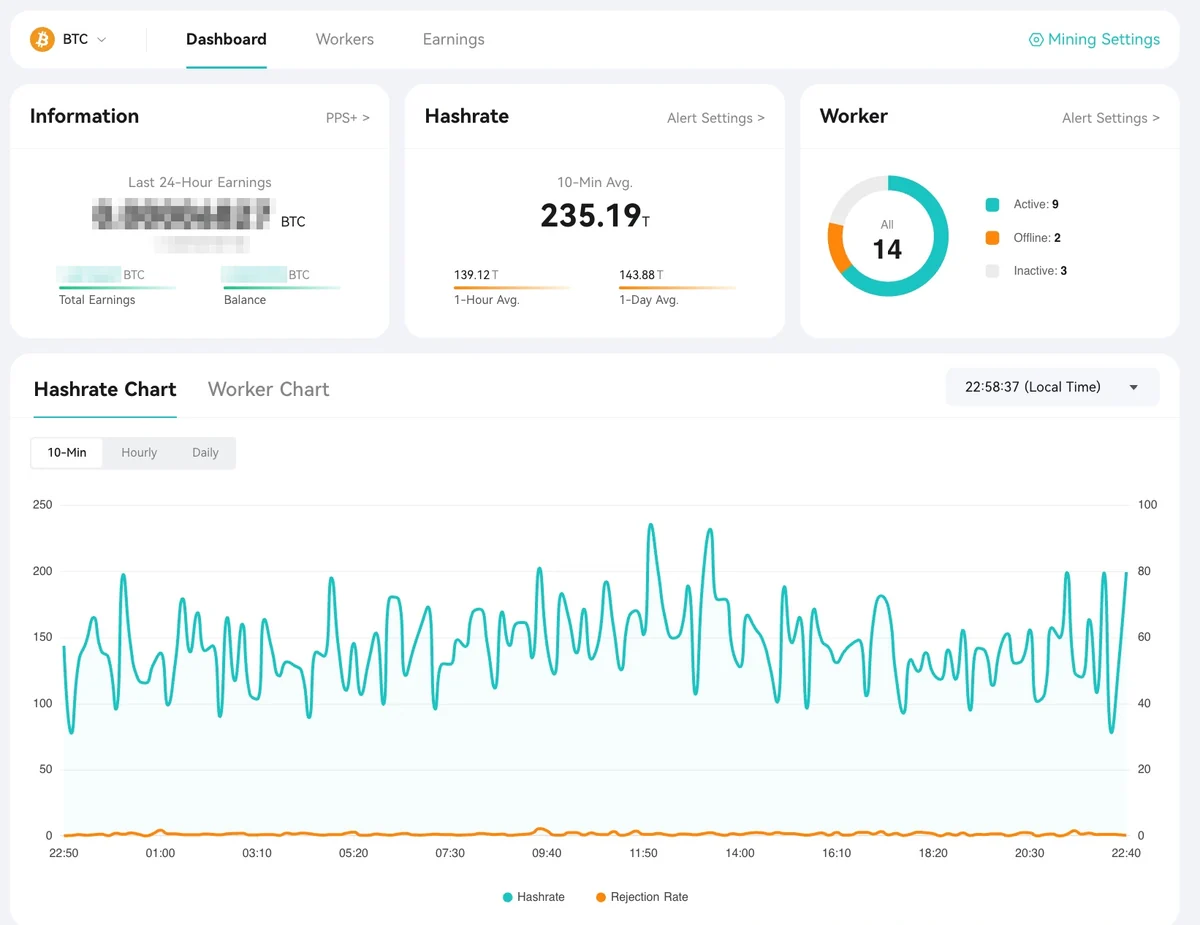
Look at days and weeks. The five minute hashrate chart is scary even on a perfectly healthy miner.
Rejected share rate, how to read it
up to 0.5%: excellent
up to 1%: acceptable
from 1%: above the daily norm
from 3%: you lose money every day
The orange line on the chart is the reject rate itself. The thresholds match the ones in the section text.
The pool dashboard answers two questions: is your hardware running at full power, and are you being paid honestly. There are not many numbers on it.
Hashrate
The pool works it out from your flow of shares, so the instant value jumps around by tens of percent, and that is normal. Compare the daily average with the spec sheet of your miner: an S21 should sit around 200 TH/s, and a steady drop of 5 percent or more is a reason to dig into diagnostics.
Accepted and rejected shares
The ratio of rejected to accepted is your main health indicator for the connection. Up to 0.5 percent is great, up to 1 is tolerable, above 3 you are losing money every day and you fix that first.
Luck
The ratio of the expected number of shares per block to the actual one. It only matters on PPLNS and TIDES: with FPPS the swings in luck are not your worry at all, the pool smooths them out.
Effective hashrate
The power that is left after rejected and stale shares come off. Your payout is calculated from exactly this figure, and the gap with the local hashrate of the miner is your network loss.
Round time
How long the pool has been looking for the current block. On its own it tells you nothing, but a long round on PPLNS explains why your balance is empty today.
A useful habit: once a week, match the payout figure against what the profitability calculator predicts for your model. A gap bigger than the pool fee plus a couple of percent for rejects means something is off: either the miner is underdelivering, or the plan is not the one you thought you signed up for.
A checking rhythm that does not eat your life
Once a day, one minute: every worker in Alive status, rejects within a percent. Better yet, hand this over to the alerts from the pool.
Once a week, ten minutes: the payout total against your estimate, the hashrate trend over 7 days, miner temperatures from the logs.
Once a month: match the plan in your dashboard against what it was when you signed up, move the balance you have piled up to your own wallet, take a look at network difficulty and the exchange rate so your payback forecast does not live in last year.
Nine out of ten "the miner will not mine" tickets at our service shop come down to the network or the configuration, not the hardware. Here is what people bring in most often.
Symptom
What it means
Where to start
Socket connect failed
the miner could not reach the pool server
check the URL and port, DNS, firewall, that tcp and ssl match
Authorization failed
the pool turned down the login
the account.worker format, typos, the rules of the pool for registering a worker
Pool offline or Dead in the interface
the connection to this pool is gone
if only the backup is alive, check the status of the first pool and your own network
Rejected: stale
the share arrived after the job changed
latency to the server, pick a European endpoint, check your Wi-Fi bridges
Rejected: duplicate
the same job was sent twice
dropped links and retries, less often firmware that misbehaves
Rejected: low difficulty
the hash fell short of the share threshold
a config knocked out of place, overclock on the edge, chip degradation
High overall reject
losses above 3 percent
provider network, router, overheating, look at every worker separately
The wording is exactly as it comes out in Antminer logs. Dead on a pool slot means the link is lost, Alive means it works.
A separate word on a steadily high share of stale shares. It is almost always geography or the last mile: a server across the ocean, an overloaded router, a miner hanging off a Wi-Fi repeater. The ASIC belongs on a cable, and the pool should answer from Europe in tens of milliseconds. Moving the endpoint from an American one to a European one takes away, in our experience, up to half of the stale shares.
Three cases from the shop
A customer complains: income is 8 percent below the calculator, the pool is "stealing". We look at the statistics: stale close to 8 percent. The miner was sitting in a back room on a Wi-Fi repeater. We moved it onto a cable, stale fell below half a percent, and the pool turned out to be honest.
Second case: Authorization failed right after signup. The guy typed the email from his account into the worker field instead of the login. The format is strictly username.miner_name, an email does not work there on any large pool.
The third one, my favorite: the miner "died" every night at four in the morning and came back on its own. In the logs, Socket connect failed at exactly the moment the router of the provider ran its scheduled restart with a new IP. The cure is a second pool slot and, properly speaking, a router that does not improvise at night.
And if the errors keep coming on a healthy network while the miner runs hot or loses hashrate, the problem has walked out of this article and into the hardware: cleaning, thermal interface, hash board diagnostics. That is our daily work, write to us on the service Telegram.
In shortA quick connectivity test to the pool from any computer on the same network: the command nc -vz btc-euro.f2pool.com 1314 will show you whether the port opens. If it does not, the trouble is in the network and not in the miner. The glossary has separate write ups on Stratum timeouts and pool ports.
A pool fee is the percentage the operator keeps out of your reward before it pays you. That number covers its servers, DDoS protection, development and, on FPPS, insurance on your income against unlucky streaks. Schemes with a guarantee cost more than schemes without one, and that is not greed, it is the price of the risk the pool takes on.
Comparing rates head to head only makes sense inside a single scheme. The correct metric is called the effective fee: how much you really failed to earn over a long period compared with an ideal pool that charges nothing. On FPPS it equals the advertised rate. On PPLNS the behavior of the window gets added on top: when you move from one pool to another, part of your shares falls out of payment, so hopping often on PPLNS eats more than it saves.
Zero percent is never free. The 0% PPLNS at Antpool is subsidized by the rest of the Bitmain ecosystem, and at small pools a zero rate is more often the sign of a startup that lives until its first cash crunch.
Look at the withdrawal fee. A threshold of 0.001 BTC with a withdrawal fee of 0.0001 means losing 10 percent if you cash out the minimum. You come out ahead by saving up to the free threshold or using Lightning.
Farms have their own price list: from 1 PH/s up, almost every pool offers custom terms, and you have to ask for them directly, through an account manager.
Withdrawal fees and the dust on your balance
The second and much less visible cost lives on the way out. Withdrawing below the free threshold costs money almost everywhere: at Braiins, for example, amounts under 0.005 BTC go out with 0.0001 held back. With a single miner that is a choice between waiting a month for the free threshold and paying a percentage for being impatient. Lightning payouts give you a third way: Braiins sends from 1 satoshi, NiceHash from 0.0001 BTC, and the fees there are token. As for leftovers smaller than the minimum threshold, that same dust, they usually burn when you close the account, so leave a pool after you withdraw, not before.
In shortYou can bring the Braiins fee down to zero with their own Braiins OS firmware, and cut the Ocean fee in half through DATUM. Pairings like these, rate plus software, often beat a bare hunt for the lowest number.
This article deliberately skips exact income figures: network difficulty and the exchange rate move faster than articles get updated. The formula, though, is stable, and it holds only five factors.
Your effective hashrate. Not the spec sheet number, but the one that reaches the pool after rejects and downtime. Three percent reject is exactly three percent less income.
Network difficulty. Network hashrate goes up, your share goes down. This is the number one killer of "it pays for itself in a year" forecasts.
The coin price. Your payout in coin is steady, its price in euros is not.
Pool fee and payout scheme. Anywhere from 0 to 4 percent of difference out of nowhere.
The price of electricity. For Spain this is the deciding factor: between the night rate and the daytime peak the difference runs several times over.
Running the numbers on a specific model is easier in our profitability calculator than in an article: it carries live parameters for 212 models, from the Antminer S21 to the L9, with power draw and your rate taken into account. Firmware adds its part too: AsicBoost in eco mode lowers power draw per watt of hashrate, and for an expensive Spanish kilowatt that shows up more than a race for gigahashes does.
Is it worth chasing a more profitable coin
Profit switching, the automatic hopping of a SHA-256 miner between BTC, BCH and XEC based on current profitability, sounds tempting and comes built into some pools. In practice the gain rarely tops a couple of percent: the arbitrage between networks on the same algorithm gets eaten before it reaches you, and every chain switch adds transition losses and turns your tax records into a puzzle of three coins. For one or two miners the game is usually not worth the candle, it is simpler to pick a network on purpose and work on what really moves your income: the power rate, rejects and temperature.
Worth knowingAny site that promises a fixed income from a pool is either out of date or selling you something else. Mining income is a function of four variables outside your control and one that is on you: keeping your miners healthy.
A pool is an account with money in it, and it gets attacked the same way an exchange account does. The set of defenses is standard, what matters is turning all of it on right after you sign up, not after an incident.
Two factor authentication through an app, not over SMS. In Spain a SIM card gets reissued through social engineering just like everywhere else.
A whitelist of withdrawal addresses with a delay on changes: a stolen password stops meaning stolen coins.
API keys on read only. Monitoring tools like mining dashboards do not need write access.
Encrypted stratum wherever it exists: it closes off payout address swapping on an untrusted network.
A separate email for the pool and alerts on login. Phishing copies of pool dashboards live in search results for years, so check the domain letter by letter.
Automatic withdrawal to your own wallet at the lowest threshold. A pool balance is not a savings account, and the Poolin bankruptcy confirmed it with a figure of 173 million dollars.
There is a separate class of risk: miners sticking out into the internet with their web interface. The factory root password on an Antminer is known to every botnet on the planet, and malicious firmware rewrites the pool address quietly. Keep your fleet behind a router, change the interface passwords and install firmware only from sources you trust: how to check a file before installing it is shown on the developer page.
If your miners sit at someone else's hosting site, there is one rule: the pool account and the payout address are in your name, not the site's. The host gets worker level access and nothing more. Arrangements where the operator "sets it all up and sends you your cut" rest purely on their word, and we have seen how that ends at the first argument over the rate.
21Decentralization: why the lineup of pools matters to everyone
Whoever builds the block decides which transactions go into it. When the right to build concentrates in two or three operators, the network gets a bottleneck, and both payment censorship and coordinated rollbacks pass through it. This is not theory, F2Pool was already filtering transactions against a sanctions list in 2023, and the early Ocean filtered by criteria of its own.
Pool
Share of blocks for the week
Foundry USA
24.85%
F2Pool
18.03%
Antpool
17.25%
SpiderPool
9.16%
ViaBTC
7.89%
MARA Pool
4.68%
Ocean
3.80%
SECPOOL
3.70%
Luxor
3.02%
Braiins
1.85%
A mempool.space snapshot for the week to August 8, 2026, 1026 blocks. The shares drift by a few points from week to week.
The two leaders hold about 43 percent of blocks, the whole top five clears 77. Reality is tighter still: according to b10c research from April 2025, around a dozen formally independent pools hand their miners Antpool templates, and the combined weight of that group stays near 30 percent of the network. You can count the actual block builders in Bitcoin today on the fingers of one hand.
Why has nobody rewritten transaction history with shares like these. A pool commands someone else's hashrate exactly as long as the owners of the miners agree to it. An attack or open censorship by the operator is visible in its own public blocks, and the hashrate scatters within hours: a miner only has to change one line in the settings. That ease of leaving is the main safety fuse in the system, which does not cancel out an unpleasant fact: the fuse only works for miners who care.
What can the owner of a couple of miners do here. More than it looks. Picking a pool is exactly how you vote: hashrate that leaves the top three for Braiins, Ocean or a solo pool directly narrows the bottleneck. The technology has caught up: Stratum V2 with Job Declaration and DATUM hand block building to the miner, and both run in production today. We keep some of our own service units on setups like these, the income is the same and the network is a little healthier.
For a miner in Valencia or any other corner of the EU, the list of pools in 2026 is shorter than the global one, and the blame goes to regulation, not hashrate.
Binance Pool is effectively closed to EU residents: the exchange did not obtain MiCA authorization, and as of July 1, 2026 its services for union countries are wound down.
EMCD and pools like it work mostly for Russia and the CIS, and their support and interfaces are tuned for that too. The pool is not on any EU sanctions list, but for a Spanish resident it is a choice with no reason behind it.
Foundry is formally available from Europe as well, but only to companies with a contract and full compliance.
Mining itself does not fall under MiCA: the regulation was written for token issuers and crypto services. Trading what you mined for euros, though, already happens on an exchange, and there a MiCA license is mandatory.
The verification map looks like this: KYC is mandatory at Foundry, Antpool and F2Pool, and selective at ViaBTC since 2026. You can work without documents at Braiins, Ocean, Luxor, solo pools and NiceHash on the mining side. A pool's anonymity does not cancel your obligations to the tax office: the income arises for you, not for the operator.
The tax part for Spain, in short. Back in consulta V3625-16 from 2016 the tax agency classified mining with organized means of production as actividad económica: that means registering in the IAE under heading 831.9 and declaring the income in your IRPF at the market value of the coins at the moment you receive them, on a scale from 19 to 47 percent. Crypto assets on foreign platforms totaling 50,000 euros or more go into Modelo 721. How your particular situation is classified depends on its scale and how it is set up.
Worth knowingWe sell and repair hardware, we do not advise on taxes. Before you start a farm, even a small one, a single visit to an asesor fiscal will save you more than all your pool fee optimization put together.
A pooled fund of computing power. Thousands of miners look for a block together, the reward is split by what each of them contributed, and that contribution is measured in shares. In exchange, members get frequent small payouts instead of rarely winning a whole block.
Does a pool mine faster than solo?
No. The total probability of finding a block does not depend on whether the miners are joined together or not. A pool removes the spread, it does not increase output: the average over years is the same, the road to it is different.
Which pool is best for Bitcoin in 2026?
There is no universal answer. For one or two miners in the EU we name Braiins most often: a low withdrawal threshold, no KYC, a European company. For a wide lineup of coins, Antpool or ViaBTC, and for those in it on principle, Ocean. Large farms belong in direct talks about the rate.
What is FPPS?
Full Pay Per Share: the pool pays a fixed amount for every share, figured from the block subsidy plus average network fees, no matter what it finds itself. The smoothest income and the highest fee, usually from 2.5 to 4 percent.
How is PPLNS different from FPPS?
On PPLNS you get paid only out of blocks the pool actually found, by your shares within a window of the last N. Your income wanders along with the pool's luck, but the fee is 1.5 to 2 points lower. Over a year both schemes converge on the same average.
What is PPS+?
A hybrid: the block subsidy is paid steadily on a PPS basis, while network fees are split only out of blocks the pool found. The swings are smaller than on PPLNS, the rate is lower than on FPPS. The main scheme at ViaBTC.
What is TIDES?
The scheme of the Ocean pool. The accounting window equals eight times network difficulty, a share is paid eight times on average, and the payout goes straight to your address in the block's coinbase transaction. There are no balances on the pool at all.
How much do pools charge in fees?
The big platforms ask from 0 to 4 percent: PPLNS is cheaper, FPPS is pricier. On top of that there may be a fee for withdrawing below the free threshold. Zero rates are always subsidized by something, so read the terms in full.
Which pools work without KYC?
Out of the ones covered here: Braiins, Ocean, Luxor and solo pools like CKPool. Ocean has no account at all, a BTC address serves as the worker. Antpool, F2Pool and Foundry require verification, and ViaBTC has been asking for it selectively since 2026.
How do you connect an Antminer to a pool?
The web interface of the unit, the miner configuration tab, three fields: pool URL, worker, password. Enter the addresses from your pool dashboard, the worker in the account.name format, the password x, and save. Ten minutes later the miner shows up in the pool statistics.
What is a worker?
The account name of a single miner on the pool, in the account.miner_name format. The pool sorts statistics by worker and sends downtime alerts the same way. The rule: one ASIC, one worker, a name you can read.
What password should you set for a worker?
Any of them, usually x. The protocol requires the field, but pools almost never check it. Your account security comes from the dashboard password and two factor auth, not from the worker password.
Can you switch pools at any moment?
Yes, it takes two minutes in the miner settings: change the addresses, restart. There are no contracts. Do not forget to withdraw what is left at the old pool: a balance lost on the way out is most often lost to forgetfulness.
Can you mine on two pools at once?
One miner works with one pool, the other slots in the interface are a backup in case of failure. Splitting a fleet, though, you can and should: half the units on one pool, half on another, and you get to compare payout fairness on your own numbers.
What is a share?
The solution to a simplified task, proof of work for the pool. A hash below the lightened threshold is something a miner finds every few seconds. From the stream of shares the pool measures your contribution and splits the reward.
What is a reject and what percentage is normal?
Rejected shares: the ones that came in late, as duplicates, or short of the threshold. Up to 0.5 percent is excellent, up to 1 is acceptable, above 3 means you hand the pool less every day and yourself nothing: look for the problem in your network or your hardware.
What is a stale share?
A share for an outdated job: while it was flying to the server, the pool had already moved on to a new block. The main cause is latency to the server. It is cured by picking a European endpoint and a cable instead of Wi-Fi.
What is pool luck?
The ratio of the expected number of shares per block to the actual one. 200 percent means the block was found twice as fast as the math said. Over distance the luck of an honest pool converges on 100, so an unlucky week tells you nothing about a pool, while years steadily below a hundred are a reason to get suspicious.
Why is the hashrate at the pool lower than what the miner shows?
The pool counts by shares, with averaging and after rejects are subtracted, the miner counts by chips before any losses. A gap of 2 to 3 percent is normal. More than that: look at rejects, stale shares and network stability.
What is Stratum V2 and do you need it?
The new version of the pool protocol: encryption and block building on the miner's side. Braiins and DMND run it in production, stock firmware still speaks only V1. V2 adds no income, it adds channel security and network independence, so turn it on out of conviction.
What is merged mining of Litecoin and Dogecoin?
The same work from a Scrypt miner counts for two networks at once: LTC as the main one and DOGE as the attached one. Pools pay out both coins, and F2Pool adds five more small networks on top. Mining DOGE on its own does not exist.
Is it realistic to find a block solo with one ASIC?
There is a chance, about one percent a year for a 200 TH/s unit at the current difficulty. People do win: across 2025 and 2026 solo miners took dozens of blocks worth 3.125 BTC each. But you cannot build a budget on it, this is a lottery with a fairly priced ticket.
When and where do payouts arrive?
Usually once a day to your address, if the minimum has piled up: the threshold at Braiins is 0.0002 BTC, at Luxor 0.001, at F2Pool 0.005. Ocean pays right in the block. Small miners are helped by Lightning payouts: the thresholds there start at a satoshi.
What happens if the pool shuts down?
Your miners will move to the backup pool in the second slot on their own, and production continues. The only thing that burns is the balance you did not withdraw, so keep it minimal. Poolin went from freezing withdrawals in 2022 to bankruptcy in 2026, four years of hope for everyone who waited.
Does the pool pay my taxes in Spain?
No. The pool keeps its fee and reports nothing to Hacienda. The duty to declare income at the market value of the coins at the moment you receive them is on you, and the details are worth going over with a tax advisor.
Does AsicBoost firmware work with any pool?
Yes, with every pool over Stratum V1, and there is no need to change pools when you reflash. The 2.8 percent DevFee goes out over a separate connection and does not show up in your statistics. Your pool settings are kept during installation.
What is a solo pool?
A service that gives you the infrastructure for solo mining: stratum, a node and block propagation for a token percentage, from 0 to 2. The reward is not split, it goes in full to whoever found the block. Examples: CKPool Solo with a server in Germany, Public Pool.
What is a subaccount?
A separate space for workers inside one login: its own statistics, its own payout address. Handy for keeping sites or clients apart: the garage on one subaccount, the container on another, and the reporting never mixes.
Do you need a VPN to connect to a pool?
Not for access from Spain: mining pools are not blocked, and a VPN only lengthens the route and adds stale shares. The exception is the policy of a particular telecom operator or corporate network, but that is rare.
Can you mine through a pool on a laptop?
You can connect, you cannot earn. The networks in this article are hashed by ASICs, and a laptop against them is millions of times weaker: in a year it would not even reach the payout threshold. For processors there is a separate world like Monero, and the RandomX algorithm page is devoted to it.
Automatic tuning of share difficulty to the power of a miner, so that shares come in at a rate that suits the pool, on the order of 16 to 20 per minute.
Round
The period from one block the pool found to the next one.
Block template
A draft block with a set of transactions. Whoever assembles the template controls the contents: the pool on V1, the miner with Job Declaration and DATUM.
Coinbase transaction
The first transaction in a block, the one that creates the reward. Ocean writes miner payouts directly into it.
PPS+
The subsidy at a fixed price, network fees out of the pool's actual blocks. The middle ground between FPPS and PPLNS.
TIDES
The Ocean scheme: a window of eight network difficulties, non custodial payouts out of the coinbase.
Job Declaration
A Stratum V2 mechanism: the miner proposes the block template and the pool only validates it. It first worked in the field on June 25, 2026 on block 955318.