


Antminer S21 200 TH/s



- Amlogic
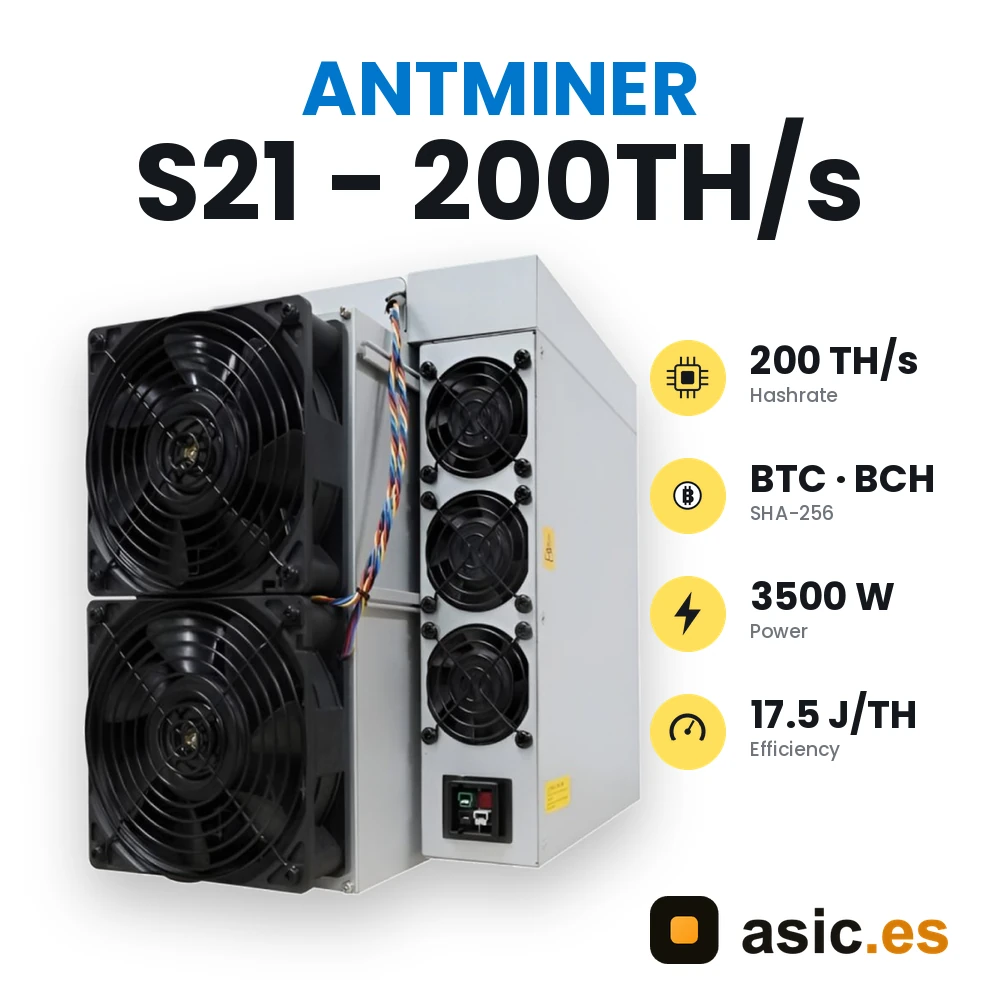
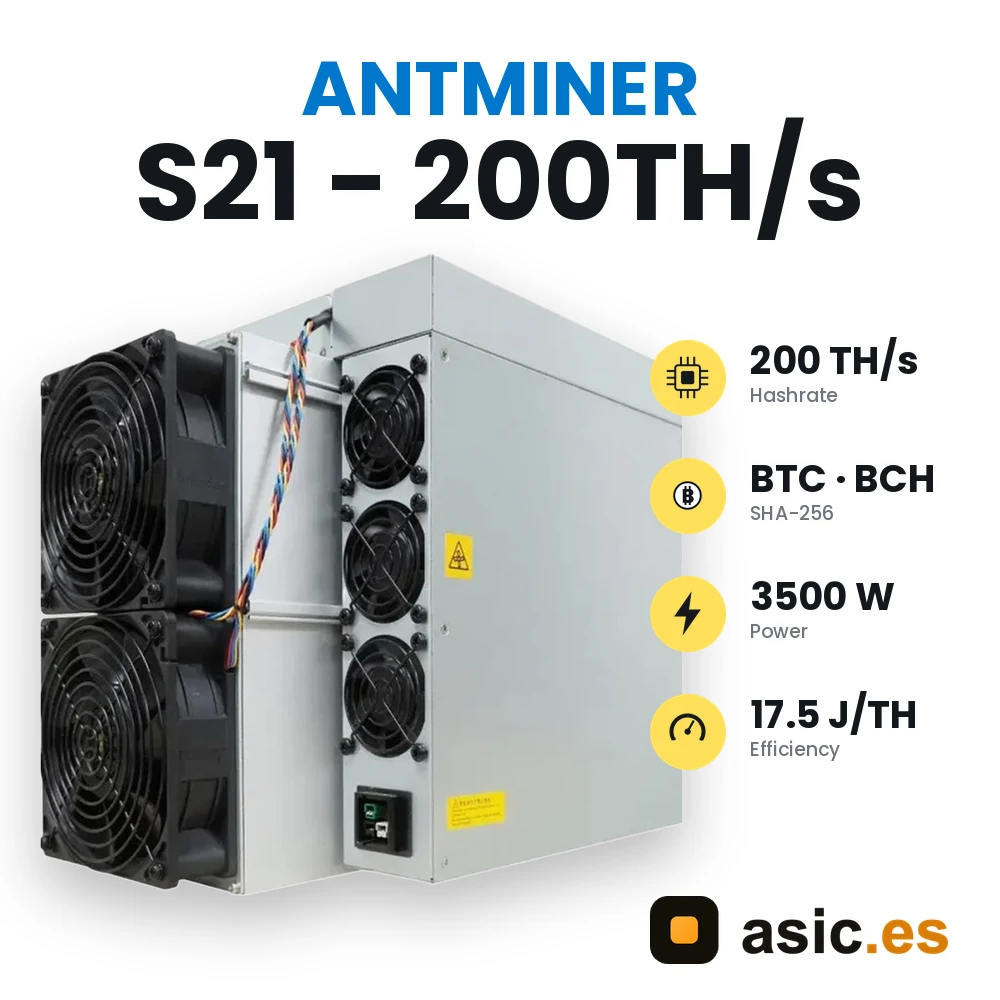
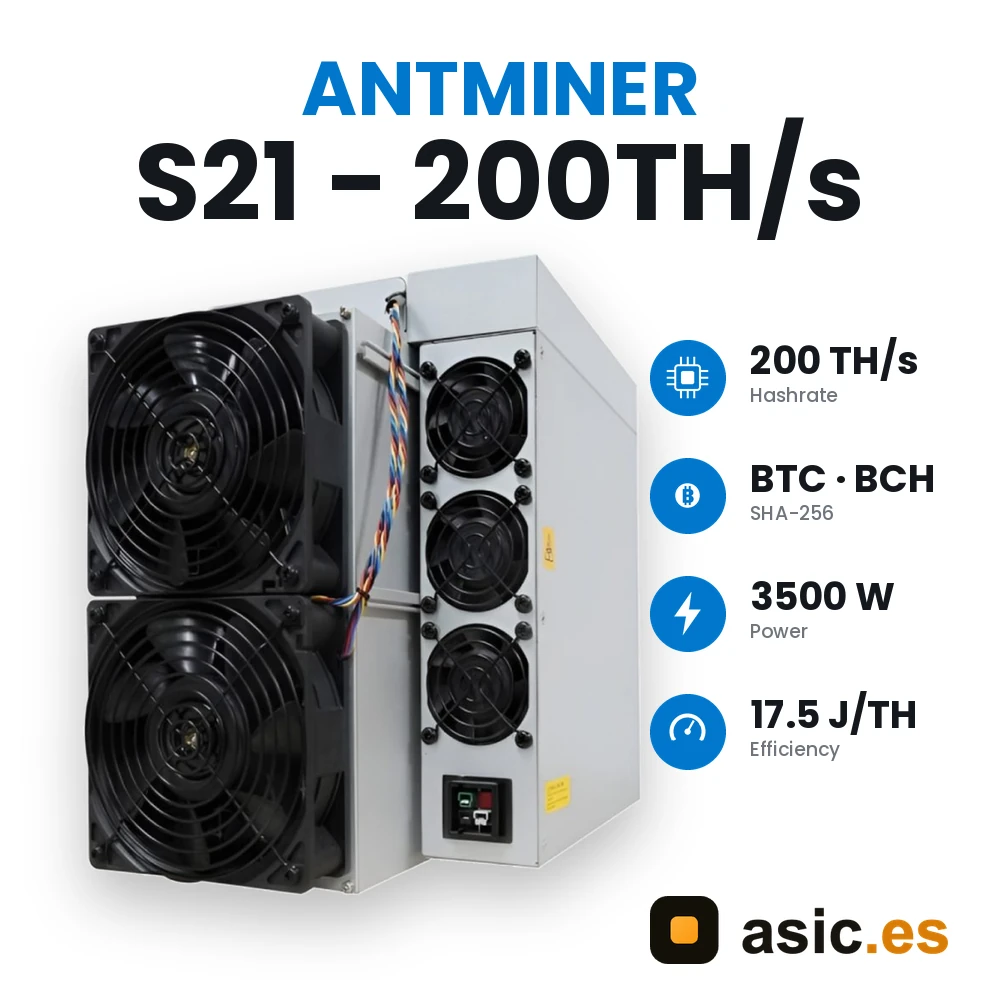
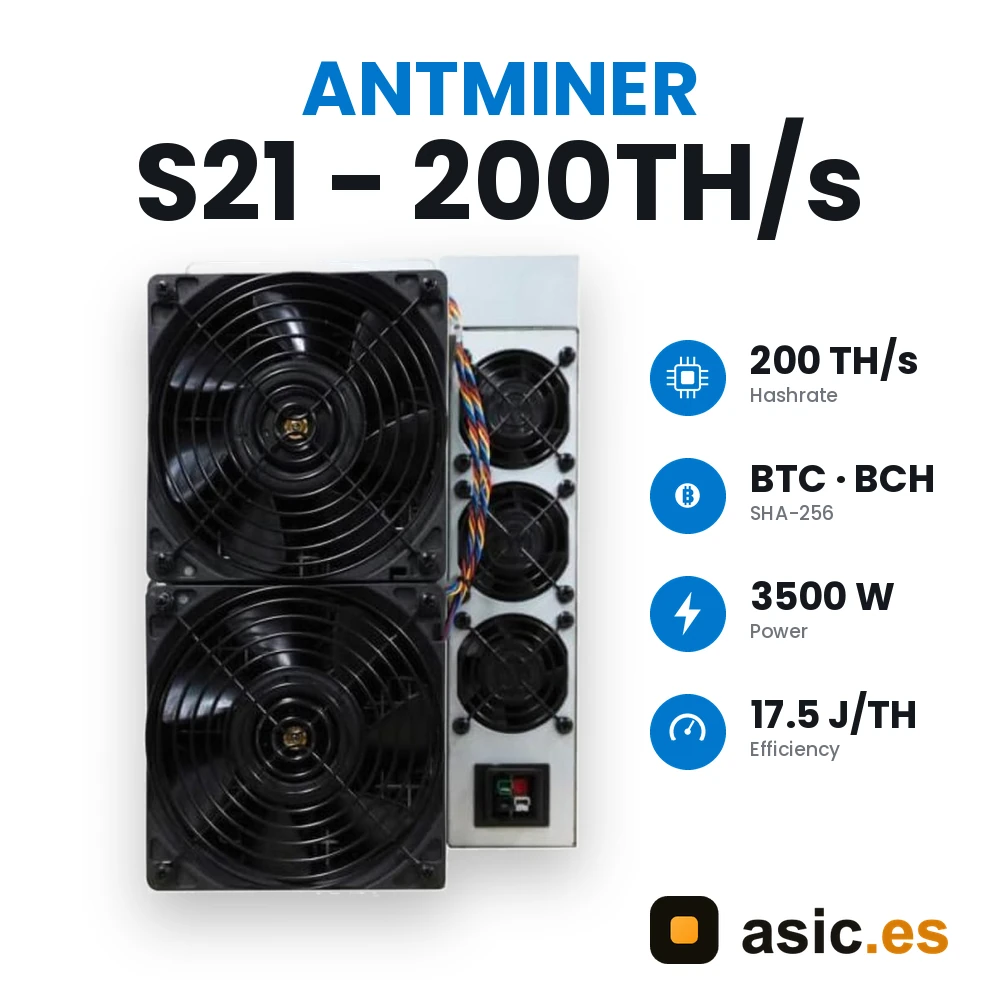
The Antminer S21 is an air cooled Bitmain ASIC for SHA-256, built on BM1368 chips. Inside there are three hash boards and 324 chips, which is where 200 TH/s at 3500 W comes from. Worked out per unit of hashing that is 17,5 joules per terahash. You can estimate earnings in the Antminer S21 profitability calculator.
Over a day the machine gets through about 84 kWh. At 0,10 € per kilowatt that is 8,40 € a day, and this figure, not the price of the hardware, decides whether the setup makes money. The S21 usually goes on a single phase in a garage or a utility room, two to six units per space.
Technical specifications
| Algorithm | SHA-256 (BTC, BCH, BSV) |
| Hashrate | 200 TH/s (±3%) |
| Power draw | 3500 W (±5%) |
| Efficiency | 17,5 J/TH |
| Chip | BM1368 |
| Hash boards | 3 |
| Chips | 324 |
| Control board | Amlogic |
| Power input | 220 to 277 V AC, single phase, built in PSU |
| Power connector | P13 |
| Cooling | Air, 4 fans |
| Noise | 75 dB |
| Connection | Ethernet |
| Weight | 14,6 kg |
How the S21 differs from neighbouring models
Against the S19 generation the difference is not the hashrate but the electricity bill. The various S19 versions sat somewhere between 21 and 30 J/TH, meaning they pay 20 to 70 per cent more in power for the same hashrate. Keeping an S19 today makes sense only where the kilowatt costs next to nothing.
The S21 series itself has hydro and immersion versions. They pull more terahashes out of one chassis, but they need a coolant loop or a tank of dielectric fluid, which means a separate room and plumbing. The air cooled S21 goes where none of that exists: a socket, a breaker, an extractor.
The Pro and XP versions use fewer joules per terahash but cost more per terahash bought. That premium only pays back on an expensive kilowatt, so do the sum against your own tariff rather than the datasheet.
What it takes to run it
3500 W continuous at 230 V works out at about 15,2 A. The line is run in 4 mm² cable at minimum, protected by a 20 A breaker and a residual current device, and the socket is shared with nothing. Single phase input, P13 connector on the miner, PSU built in. How cable size and breaker rating are worked out: power supply and wiring for an ASIC miner.
After that the miner has to be found on the network and pointed at a pool. Its IP address is reported by the IP Reporter utility, everything else is set in the web panel. The step by step procedure: how to configure an ASIC miner.
Cooling and noise
The 3,5 kW come back into the room almost entirely as heat, roughly three electric kettles running without a break. Cooling is by air, four fans, and the datasheet noise figure is 75 dB. From four machines in one room the intake and the extraction are already kept apart. Airflow sizing and the noise section: cooling ASIC miners.
Firmware
We sell it on factory Bitmain firmware, with no third party builds. The same page holds the stock firmware files with their checksums, in case the miner ever needs recovering.