


ASIC power draw and planning the electrical supply
Power: typical ranges and what depends on them
This part is about watts as such: how many of them there are, what they mean for your wiring and why headroom is not worked out from the average value.
| Consumption | How to read it |
|---|---|
| 2000 to 3000 W | Low, economy profiles and older models |
| 3000 to 3500 W | The normal working range of current models |
| above 3500 W | High consumption, overclocking profiles and hydro |
How power ties into the rest
Power, hashrate and efficiency are three sides of one triangle. Raise the frequency and both hashrate and watts go up, while efficiency usually gets slightly worse. Drop the voltage and watts fall faster than hashrate, so efficiency improves. Any change in the performance section moves all three numbers at once.
Sizing the line, short and to the point
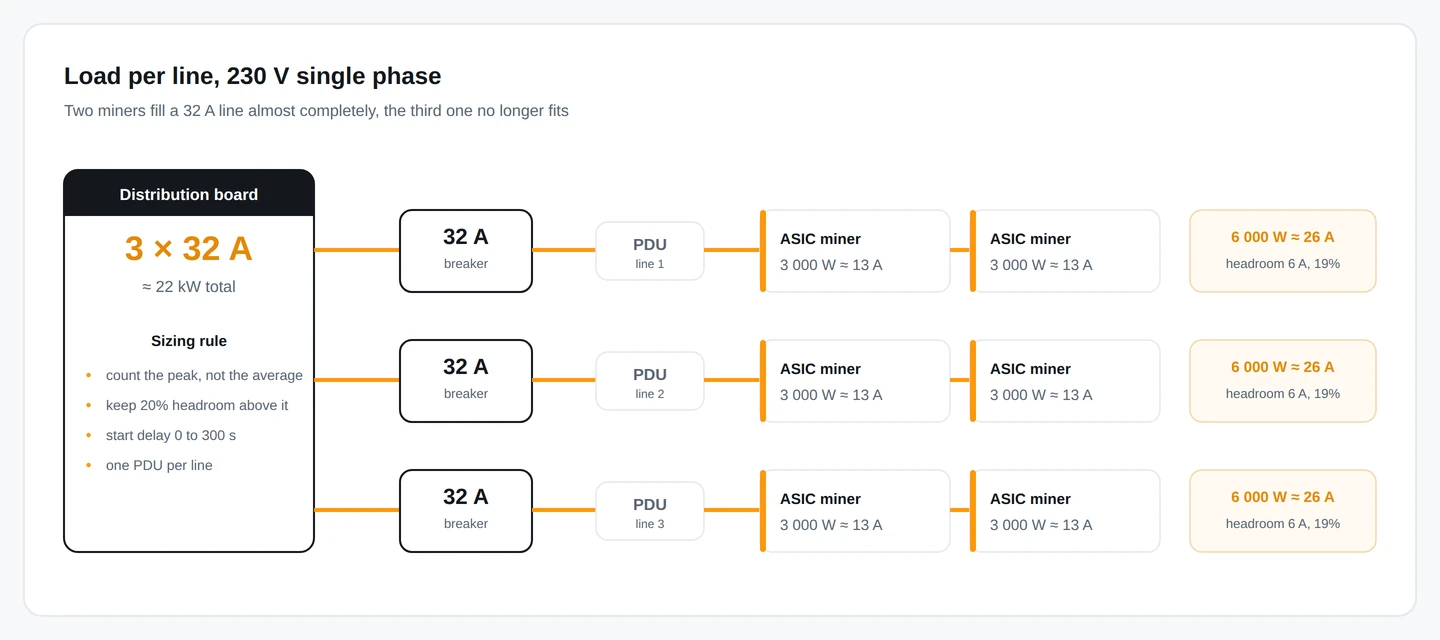
- Work from the peak consumption of the profile, not from the average. The peak comes at initialization and at the moments when the fans go to maximum.
- Leave at least 20% headroom above the peak. A breaker that trips once a week costs more than one taken a step larger right away.
- A single phase 32 A line is about 7 kW at 230 V. Three air cooled S21 units will not fit there, plan ahead.
- Starting a whole fleet at once gives a peak load. The firmware has a random start delay of 0 to 300 seconds for this, see advanced settings.
- A consumption limit can also be set in software: automatic profile switching can lower the preset when the limit is exceeded. The setting is in the performance section.
About the power supply
The stock PSU is sized for stock mode with a little headroom. Under overclocking it hits its
limit and goes into protection, and the firmware sees this as chains dropping out. If you are
planning serious overclocking, the power supply question gets settled before, not after.
Quick answers
How many ASICs can go on a 32 A line?
At 230 V that is about 7 kW. Two air cooled S21 units take up nearly all of it, a third one will no longer fit with the headroom you need.
Why does consumption rise in summer on the same settings?
The fans spin faster and eat more, plus hot chips need more voltage to stay stable.